Engineering & Permitting services give our clients a clear, approved path to construction before the first crew arrives on site. Every deployment begins with the same questions: whether the poles can carry a new attachment, what the route will demand, and how long approvals will take. Those answers cost the least when they come early, and that is where our engineering work begins.
From field data collection and structural analysis through permit applications, DOT and railroad crossings, and permit rideouts, we manage the details that most often stall a project between design and construction. Our working relationships with pole owners, utilities, and local authorities help clients avoid rejected applications and extended review cycles. With a focus on accuracy and preparation, National OnDemand builds the engineering foundation that keeps our clients\' deployments on schedule.

Make Ready Engineering
Make ready is where aerial deployments most often lose time. Before a new attachment can be placed, every pole along the route must be evaluated for clearance and capacity, and each existing attacher must complete its own rearrangements in sequence. A single overlooked conflict can send an application back to the pole owner and restart the review clock.
Our engineers survey each pole in the field, documenting heights, attachments, spans, and clearances, then design the make ready work required to bring every structure into compliance with NESC and pole owner standards. Our clients receive complete application packages and clearly defined work orders for each party on the pole, so owners and attachers know exactly what is expected of them and when it needs to happen.
Pole Loading
Every new attachment adds weight, wind load, and tension to a structure that may already be carrying decades of equipment. When a pole fails loading analysis after an application has been submitted, the result is often a redesign, an unbudgeted pole replacement, and weeks of added delay.
We perform structural loading analysis on each pole in the design, modeling existing and proposed attachments against the wind, ice, and strength requirements of the NESC and the pole owner. Where a structure falls short, we recommend the most practical remedy, whether guying, rearrangement, or replacement, and document the results in the format the owner requires. Our clients submit their applications with confidence that the engineering behind them will hold up to review.
Pole Inspection
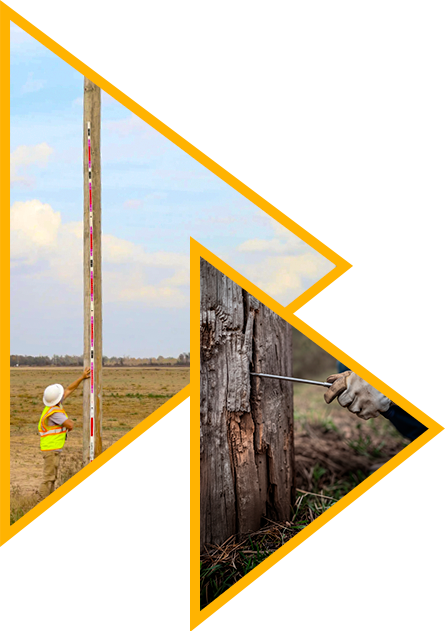
Aging infrastructure creates risk for every party attached to it. Decay, damage, excessive lean, and clearance violations are far less costly to identify during an inspection than after a crew has been dispatched or a storm has exposed them.
Our field teams inspect poles for condition, structural integrity, and compliance, capturing measurements, photographs, and precise location data for every structure. Findings are delivered as GIS-compatible data that integrates with our clients' mapping and asset management systems, giving owners and attachers an accurate record of what is standing in the field. Following storm events, the same teams provide damage assessments and recommendations that help our clients restore service and strengthen their systems against the next one.
TCP Packages
Work in or near the roadway cannot begin until the traffic control plan is approved, and an incomplete or noncompliant plan is one of the most common reasons a right-of-way permit stalls. That same plan determines how safely crews and the public move through the work zone once construction begins.
We prepare complete Traffic Control Plan packages in accordance with the MUTCD and the requirements of each state DOT and local jurisdiction, detailing lane closures, signage, flagging operations, and work zone layouts specific to each site. Packages are prepared alongside permit applications so both move through review together. Our clients gain faster approvals, safer job sites, and field crews who know exactly how each work zone should be set up.
Construction Feasibility
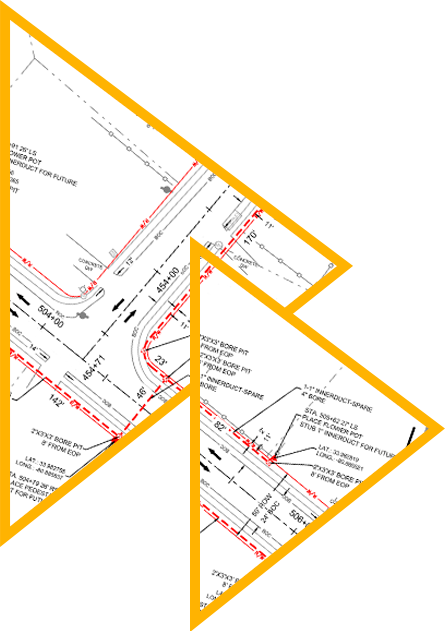
The most expensive surprises in fiber construction are the ones discovered after crews have mobilized. Rock, congested utility corridors, railroad and highway crossings, environmental restrictions, and limited rights-of-way can each change the cost, method, and schedule of a route.
Our feasibility studies evaluate proposed routes through desktop analysis and field review before design is finalized, identifying constraints and comparing aerial and underground options wherever both are viable. Our clients receive a clear assessment of permitting requirements, construction risk, and the methods best suited to each segment, allowing them to set realistic budgets and schedules from the start. National OnDemand helps our clients commit to a route knowing it can be built as planned.
Let’s Talk About Your Project.
Thanks for clicking to get started — you're just a step away from connecting with our team. Share a few details about your project, and we’ll take it from here.
(c) 630-408-9877
(o) 877-263-1052 x9385
janet.sanford@nationalondemand.com
(c) 336-516-4356
(o) 877-263-1052 x1052
wade.boteler@nationalondemand.com

